
Everything You Need to Know About Your Tires and wheels: Size, Ratings, DOT and Safety
Understanding the markings on a tire sidewall is essential for choosing the right tires, driving safely and extending the life of your vehicle. Here is a simple guide to decoding tire size, load and speed ratings, the DOT code, XL/LT markings, UTQG specifications, as well as the differences between symmetrical, asymmetrical, directional and non-directional tires.
Knowing how to read these markings helps you choose a tire suited to your vehicle, your driving habits and local road conditions, whether you drive in the city, on the highway, in the rain or in winter. Understanding the tread pattern also helps you better evaluate comfort, grip, water evacuation and proper installation practices.
1. Decoding Tire Size: Example 215/55R18
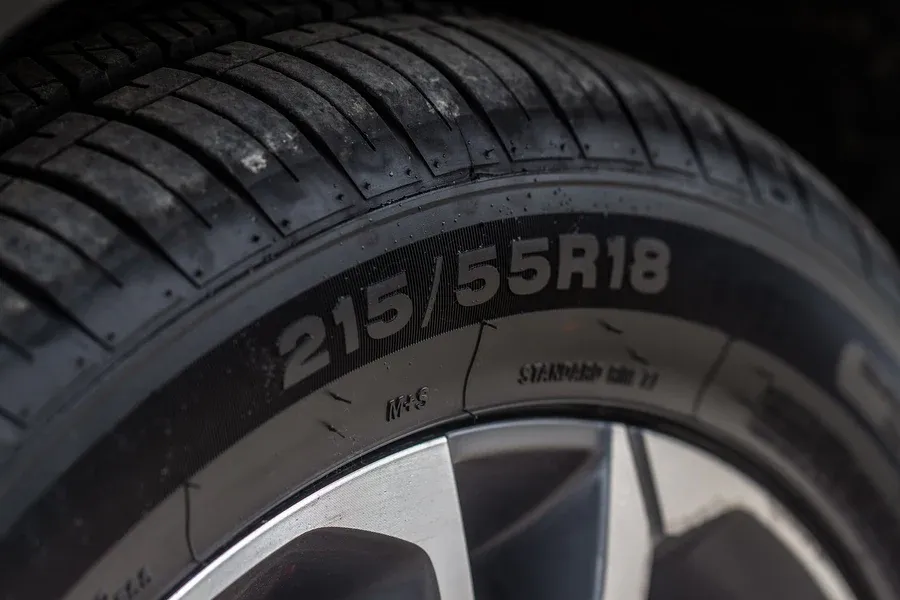
Tire size is often the most visible piece of information. Let’s use 215/55R18 as an example.
- 215 - width: the width of the tire in millimetres, from one sidewall to the other. The higher this number, the wider the tire.
- 55 - aspect ratio: the sidewall height expressed as a percentage of the tire width. In this case, the sidewall height is 55% of 215 mm.
- R - construction: means Radial, the most common tire construction used today.
- 18 - diameter: the rim diameter in inches. This tire must be mounted on an 18-inch wheel.
A lower aspect ratio, such as 35 or 40, usually indicates a low-profile tire, often used on vehicles with a sportier driving feel.
2. Understanding Wheel and Rim Terms
When reading a tire size such as 215/55R18, the final number indicates the wheel diameter or rim diameter. In this example, the tire must be installed on an 18-inch wheel. Choosing the right rim is just as important as choosing the right tire size, because the wheel must match the vehicle's fitment requirements.
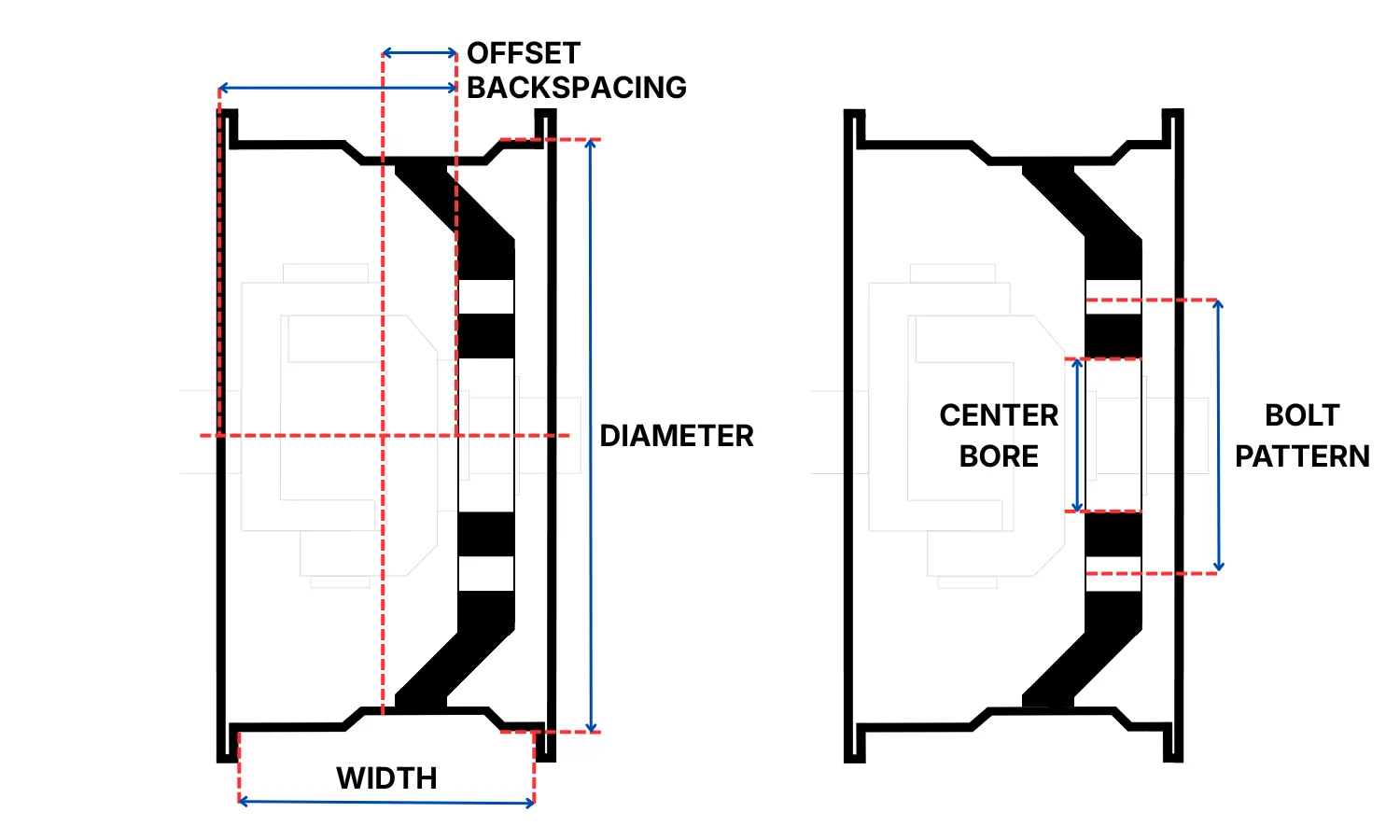
Wheel Diameter
The wheel diameter is the size of the rim measured in inches. A tire marked R18 must be mounted on an 18-inch wheel. A tire cannot be installed on a wheel with a different diameter.
Wheel Width
Wheel width affects how the tire sits on the rim. Each tire size has an approved wheel width range. A wheel that is too narrow or too wide can affect tire wear, handling and safety.
Bolt Pattern
The bolt pattern indicates how many wheel bolts the vehicle uses and the spacing between them. For example, 5x114.3 means the wheel has 5 bolt holes with a 114.3 mm bolt circle. The bolt pattern must match the vehicle.
Offset
Wheel offset determines how far the wheel sits inward or outward from the hub. Incorrect offset can cause rubbing, poor handling or clearance issues with brakes and suspension components.
Center Bore
The center bore is the hole in the middle of the wheel that fits over the vehicle hub. If the center bore is too small, the wheel will not fit. If it is larger, hub-centric rings may be required.
3. Understanding a Tire’s Load Index and Speed Rating
On the sidewall of a tire, after the size, you will often find a combination such as 91V. The number represents the tire load index, and the letter represents the speed rating. These two details help confirm that the tire is suitable for the vehicle’s weight, driving characteristics, and manufacturer recommendations.
For example, in 225/45R17 91V, 91 indicates the maximum load each tire can support, while V indicates the approved maximum speed rating. When choosing tires in Quebec or anywhere in Canada, always follow the minimum ratings listed in the vehicle owner’s manual or on the tire information label located on the driver’s door frame.
Tire Load Index
The load index refers to the maximum weight a tire can support when it is inflated to the proper pressure. The higher the index, the more weight the tire can carry. This information is important for cars, SUVs, pickup trucks, and vehicles used with passengers, luggage, or heavier loads.
A tire with a load index that is too low can wear faster, generate more heat, and provide less stability. The table below helps you quickly convert each tire load index into the maximum load per tire, in pounds.
Important: never install a tire with a load index lower than the one recommended by the vehicle manufacturer.
| Index | Load (lb) |
Index | Load (lb) |
Index | Load (lb) |
|---|---|---|---|---|---|
| 75 | 852 | 101 | 1819 | 127 | 3858 |
| 76 | 882 | 102 | 1874 | 128 | 3968 |
| 77 | 908 | 103 | 1929 | 129 | 4079 |
| 78 | 937 | 104 | 1984 | 130 | 4189 |
| 79 | 963 | 105 | 2039 | 131 | 4299 |
| 80 | 992 | 106 | 2094 | 132 | 4409 |
| 81 | 1019 | 107 | 2149 | 133 | 4541 |
| 82 | 1047 | 108 | 2205 | 134 | 4674 |
| 83 | 1074 | 109 | 2271 | 135 | 4806 |
| 84 | 1102 | 110 | 2337 | 136 | 4938 |
| 85 | 1135 | 111 | 2403 | 137 | 5071 |
| 86 | 1168 | 112 | 2469 | 138 | 5203 |
| 87 | 1201 | 113 | 2535 | 139 | 5357 |
| 88 | 1235 | 114 | 2601 | 140 | 5512 |
| 89 | 1279 | 115 | 2679 | 141 | 5677 |
| 90 | 1323 | 116 | 2756 | 142 | 5842 |
| 91 | 1356 | 117 | 2833 | 143 | 6008 |
| 92 | 1389 | 118 | 2910 | 144 | 6173 |
| 93 | 1433 | 119 | 2998 | 145 | 6393 |
| 94 | 1477 | 120 | 3086 | 146 | 6614 |
| 95 | 1521 | 121 | 3197 | 147 | 6779 |
| 96 | 1565 | 122 | 3307 | 148 | 6944 |
| 97 | 1609 | 123 | 3417 | 149 | 7165 |
| 98 | 1653 | 124 | 3527 | 150 | 7385 |
| 99 | 1709 | 125 | 3638 | ||
| 100 | 1764 | 126 | 3748 |
Tire Speed Rating
A tire speed rating is the letter placed after the load index, for example 91V. It indicates the maximum speed the tire can support with the vehicle’s load, proper air pressure, and normal driving conditions.
This rating also affects how the tire behaves on the road. A speed rating that is too low can make steering less precise, reduce highway stability, affect braking, and change handling, especially during lane changes or cornering.
Key point: do not choose a speed rating based only on posted speed limits. Follow the recommended rating to maintain the vehicle’s intended stability, steering response, and handling.
| Code | Maximum Speed (km/h) |
Code | Maximum Speed (km/h) |
|---|---|---|---|
| L | 120 | T | 190 |
| M | 130 | U | 200 |
| N | 140 | H | 210 |
| P | 150 | V | 240 |
| Q | 160 | Z | Over 240 |
| R | 170 | W | 270 |
| S | 180 | Y | 300 |
4. What Do XL, LT, Run Flat and Ply Rating Mean on a Tire?
In addition to the tire size, load index and speed rating, several other markings may appear on a tire's sidewall. These markings provide information about the tire's load capacity, the type of vehicle it is designed for and special technologies such as Run Flat tires.
XL (Extra Load)
The XL (Extra Load) marking indicates that the tire has been reinforced to withstand higher inflation pressures and carry more weight than a standard tire of the same size. XL tires are commonly used on SUVs, electric vehicles, heavier sedans and certain performance vehicles.
- Higher load capacity: supports more weight than a standard tire of the same size.
- Reinforced construction: built with a stronger casing to handle higher inflation pressures.
- Follow the manufacturer's recommendations: if your vehicle came equipped with XL tires, it is recommended to replace them with the same specification.
LT (Light Truck)
The LT (Light Truck) marking identifies a tire designed for pickup trucks, commercial vans, utility vehicles and certain SUVs used for towing or carrying heavy loads, for example 245/75R16LT.
- Heavy-duty construction: reinforced sidewalls and a stronger casing.
- Higher load capacity: designed to carry heavier loads and withstand demanding use.
- Towing: particularly well suited for vehicles that frequently tow trailers or campers.
What Does Ply Rating Mean?
Many LT tires feature markings such as 6 Ply, 8 Ply, 10 Ply or 12 Ply. Contrary to popular belief, these numbers no longer represent the actual number of layers in the tire's construction.
Modern tire materials provide much greater strength with fewer layers. Today, the ply rating represents an equivalent load capacity. The higher the ply rating, the more weight and inflation pressure the tire is designed to handle.
- 6 Ply: generally suitable for light-duty pickup trucks and moderate loads.
- 8 Ply: provides a higher load capacity for heavier-duty applications.
- 10 Ply: recommended for frequent towing, heavy loads and full-size pickup trucks.
- 12 Ply and higher: primarily intended for commercial vehicles and the most demanding applications.
Good to know: a 10-ply tire is not automatically better than a 6-ply or 8-ply tire. The correct ply rating depends on your vehicle manufacturer's recommended load requirements.
What Is a Run Flat Tire?
A Run Flat tire is designed to continue driving temporarily after a puncture or complete loss of air pressure. Thanks to its reinforced sidewalls, it can support the vehicle's weight for a limited distance, allowing the driver to safely reach a repair shop without immediately changing the tire.
- Safety: helps maintain vehicle control after a loss of air pressure.
- Limited driving distance: most manufacturers recommend driving no more than approximately 80 km (50 miles) at a maximum speed of about 80 km/h (50 mph) after a puncture.
- TPMS required: Run Flat tires should normally be used with a Tire Pressure Monitoring System (TPMS).
- Repair: depending on the extent of the damage, a Run Flat tire often needs to be replaced rather than repaired.
Run Flat tires are commonly installed as original equipment on many BMW, MINI, Mercedes-Benz, Lexus, Cadillac and other premium vehicle models.
5. The DOT Code: How to Know a Tire’s Year of Manufacture
The DOT code indicates, among other things, the tire’s manufacturing date. The last four digits tell you the week and year the tire was produced.
Example: 0720
- 07: week of manufacture
- 20: year of manufacture
This tire was therefore manufactured during the 7th week of 2020.

Good to know: at 4Tires.ca, we make sure not to ship tires with a DOT code older than 2 years.
A recent DOT of 1 or 2 years is not something to worry about. When a tire has been properly stored for 1 or 2 years, it does not affect its real service life once installed on the vehicle. What matters most is choosing a tire that meets the manufacturer’s recommendations and suits your driving needs.
6. UTQG Specifications: Treadwear, Traction and Temperature
UTQG, or Uniform Tire Quality Grading, is an American rating system found on most summer and all-season tires. It provides information about durability and performance.
- Treadwear: indicates tread wear. A tire rated 600 should theoretically last twice as long as a tire rated 300.
- Traction: rated AA, A, B or C. It measures the tire’s ability to stop on wet pavement in a straight line.
- Temperature: rated A, B or C. It indicates the tire’s resistance to heat generated at high speed.
Good to know: winter tires generally do not display a UTQG rating. This is normal because the system is designed to compare tires tested under standardized conditions, mainly on dry or wet pavement. Winter tires are instead evaluated based on cold-weather performance, snow, ice and winter driving conditions.
7. Symmetrical, Asymmetrical, Directional and Non-Directional Tires: What Is the Difference?
The tread pattern directly influences handling, comfort, noise level, water evacuation and wet-road performance. Tires can be symmetrical or asymmetrical, but also directional or non-directional.
Symmetrical Tires
A symmetrical tire has the same tread pattern on the inner and outer sides of the tire. This type of design is common on many passenger vehicles because it offers a good balance of comfort, durability and quiet driving.
- Comfort: generally provides a smooth and quiet driving experience.
- Durability: often promotes even wear when the tires are properly maintained and regularly rotated.
- Versatility: suitable for everyday driving, city driving and highway use.
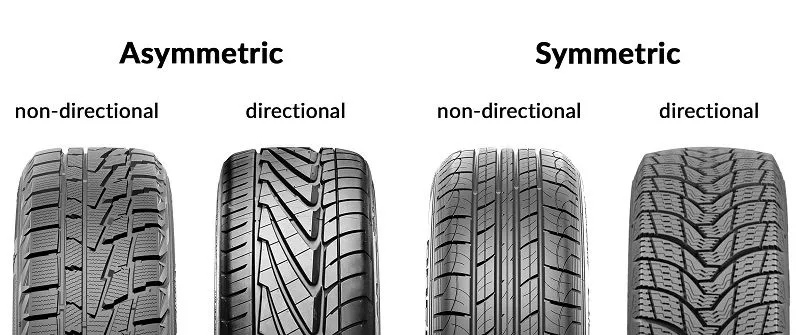
Asymmetrical Tires
An asymmetrical tire has a different tread design between the inner and outer sections of the tread. The inner section is often designed to better evacuate water, while the outer section is optimized for cornering stability and grip.
- Wet-road performance: the inner area helps evacuate water and reduce the risk of hydroplaning.
- Handling: the outer area provides better stability when cornering.
- More dynamic driving: often used on premium touring tires, performance tires or sport-oriented tires.
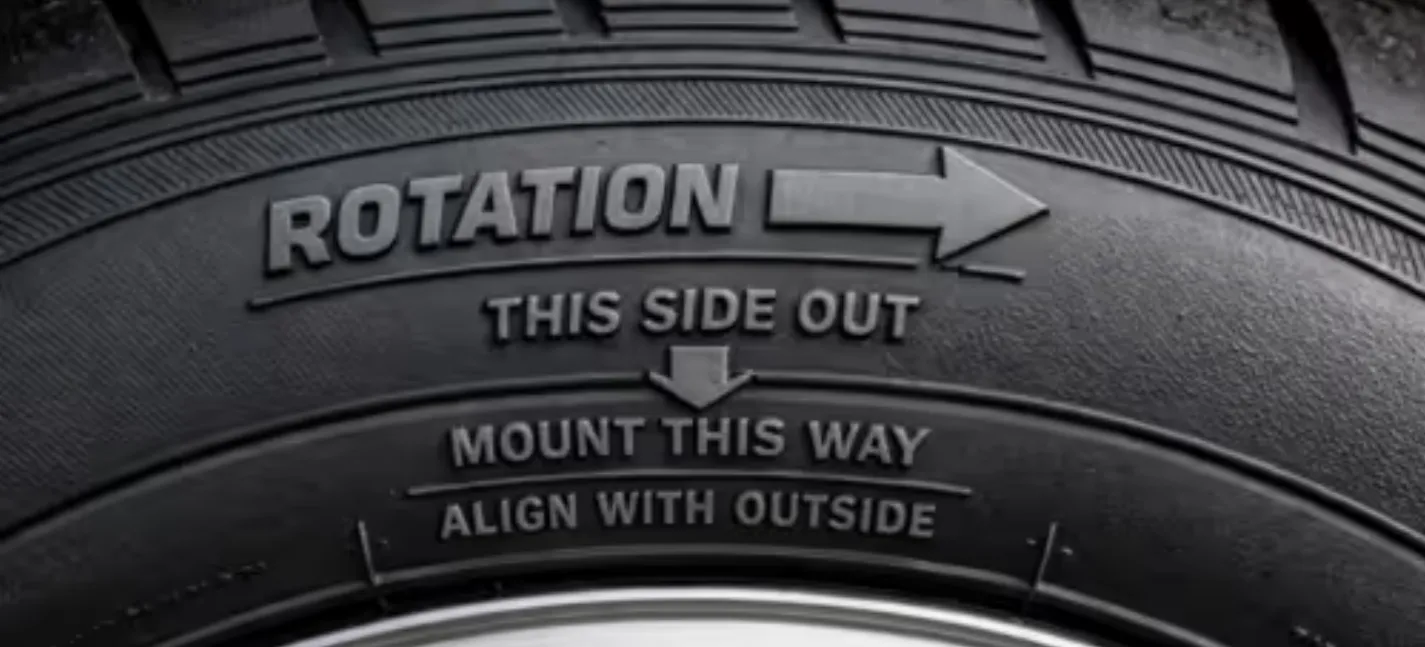
Important: asymmetrical tires must be installed the right way, with the correct side facing outward on the vehicle. Look for the Outside and Inside markings on the tire sidewall before installation.
Directional and Non-Directional Tires
In addition to being symmetrical or asymmetrical, a tire can also be directional or non-directional. This characteristic indicates whether the tire must rotate in a specific direction or whether it can be installed in either direction of rotation.
Directional Tires
A directional tire has a tread pattern designed to rotate in one specific direction. Its pattern often forms a V-shape or arrow-like design, which helps channel water, slush or mud away from the tire.
- Installation: the tire must follow the rotation direction indicated by an arrow on the sidewall.
- Performance: it often provides better water evacuation and good grip on wet pavement.
- Rotation: it is generally rotated from front to rear on the same side of the vehicle, unless the tire is removed from the wheel.
Non-Directional Tires
A non-directional tire can rotate in both directions. It does not have a mandatory rotation direction, which makes installation and tire rotation easier.
- Installation: the tire can be mounted in either direction of rotation, unless otherwise indicated by markings such as Inside or Outside.
- Versatility: it is well suited to everyday driving and standard road use.
- Rotation: it allows more flexibility when rotating tires, according to the manufacturer’s recommendations.
Important: a directional tire installed in the wrong direction may lose effectiveness, especially in rain, snow or slippery conditions. Always check the rotation arrows or markings visible on the sidewall before installation.
In general, symmetrical and non-directional tires are good choices for drivers looking for comfort, durability and easier rotation. Asymmetrical and directional tires are better suited for drivers who want improved wet-road grip, more precise handling and more responsive performance.
How to Choose the Right Tires for Your Vehicle
Before buying new tires, always check the manufacturer’s recommendations. They are usually found in the owner’s manual or on the sticker located inside the driver’s door frame.
For safe, economical driving suited to your region, consider tire size, load index, speed rating, year of manufacture, season and your driving habits.
FAQ About Tire and Wheel Markings
What does 205/55R16 mean on a tire?
205 indicates the tire width in millimetres, 55 is the sidewall aspect ratio, R means radial construction and 16 indicates the rim diameter in inches.
Is a tire with a DOT code of 1 or 2 years still good?
Yes. At 4Tires.ca, we do not ship tires with a DOT code older than 2 years. A tire manufactured this year or the previous year, when properly stored, remains an excellent choice and should not worry the customer.
Can I install a tire with a lower load index?
No. You should always meet or exceed the load index recommended by the manufacturer in order to preserve safety, handling and vehicle durability.
What is the difference between an XL tire and a standard tire?
An XL tire, or Extra Load tire, is reinforced to support higher inflation pressure and a heavier load than a standard tire of the same size.
What does the R18 mean in a tire size?
The R means radial construction, and 18 indicates that the tire must be mounted on an 18-inch wheel or rim.
Can I install any rim with the right diameter?
No. The diameter must match, but you also need the correct width, bolt pattern, offset, center bore and load rating.
What is the difference between mags and rims?
In common use, mags usually refer to alloy wheels, while rims can refer to either steel wheels or alloy wheels.
